Plan your visit to Barcelona Cathedral
Barcelona Cathedral is the city’s main Gothic cathedral, best known for its cloister of 13 white geese, Saint Eulalia’s crypt, and rooftop views over the old city. The visit is compact rather than overwhelming, but timing still matters because the space shifts quickly from quiet and contemplative to crowded and photo-led by late morning. The biggest difference between a rushed visit and a rewarding one is knowing that the cloister, roof, and side chapels deserve as much attention as the nave. This guide covers hours, dress code, entrances, tickets, and the smartest route.
Quick overview: Barcelona Cathedral at a glance
If you want the cathedral to feel like more than a quick photo stop, plan around worship hours, dress code, and the rooftop elevator queue.
- When to visit: Monday–Friday during tourist hours, roughly 9:30am–6:30pm, is easiest for most visitors. Weekday opening hour is noticeably calmer than 11:30am–2pm in June–August, because tour groups and Gothic Quarter foot traffic build fast through the nave and cloister.
- Getting in: From €16 for standard entry. Guided tours usually start from about €25. You can often buy close to your visit date, but summer weekends and the most convenient morning slots are better booked ahead.
- How long to allow: 45–75 minutes for most visitors. It pushes closer to 90 minutes if you use the audioguide properly and include the rooftop terraces.
- What most people miss: The chapter house museum through the cloister, and the Holy Christ of Lepanto chapel, which many people walk past without looking up at the leaning crucifix.
- Is a guide worth it? Yes, if you want the heraldry, saint legends, and Catalan history explained clearly; otherwise, the included audioguide is enough for a shorter self-guided visit.
Jump to what you need
🕒 Where and when to go
🗓️ How much time do you need?
🎟️ Which ticket is right for you?
🗺️ Getting around
♿ Facilities and accessibility
🚫 Rules and restrictions
🗒️ Practical tips
🏛️ What else to visit?
🥗 Eat, shop and stay
Where and when to go
How do you get to Barcelona Cathedral?
Barcelona Cathedral sits in the Gothic Quarter, a short walk from Jaume I station and about 10–12 minutes on foot from Plaça de Catalunya.
Pla de la Seu, s/n, Ciutat Vella, 08002 Barcelona, Spain
- Metro: Jaume I (L4) → 3-minute walk → Exit toward Plaça de l’Àngel for the most direct approach.
- Metro: Catalunya (L1/L3) → 10–12-minute walk → Walk down Portal de l’Àngel into the Gothic Quarter.
- Bus: V15, V19, 47, 120 → nearest stops a few blocks away → final approach is through pedestrian streets.
- Taxi / rideshare: Drop-off at Plaça Nova → 1–2-minute walk → easiest option if you’re avoiding cobbled lanes with luggage.
Which entrance should you use?
The cathedral is straightforward once you’re in front of it, but visitors often confuse free worship access with the full cultural-visit entrance. For most visits, use the main tourist entrance and have your ticket ready before security.
- Located at the main cathedral entrance on Pla de la Seu. Expect 5–10 minutes’ wait on quiet mornings and up to 20–30 minutes around noon in summer or on weekends.
When is Barcelona Cathedral open?
- Monday–Friday: 9:30am–6:30pm
- Saturday: 9:30am–5:15pm
- Sunday: 2pm–5pm for cultural visits
- Early morning and parts of the evening: Prayer and worship access only
- Last entry: About 45 minutes before closing
When is it busiest? Late morning to early afternoon, especially on weekends and from June through August, when tour groups, rooftop queues, and photo traffic all peak at once.
When should you actually go? Weekdays right after opening are best, because the cloister is quieter, the nave still feels like a church rather than a thoroughfare, and the roof line is shortest.
Which Barcelona Cathedral ticket is best for you
| Ticket type | What's included | Best for | Price range |
|---|---|---|---|
Cultural visit ticket | Cathedral entry + cloister + choir area + rooftop terraces + virtual audioguide | A flexible self-guided visit where you want the full cathedral rather than just a quick worship stop | From €16 |
Guided Cathedral tour | Entry + licensed guide + cathedral highlights | A first visit where you want the legends, symbolism, and history explained without relying on your phone | From €25 |
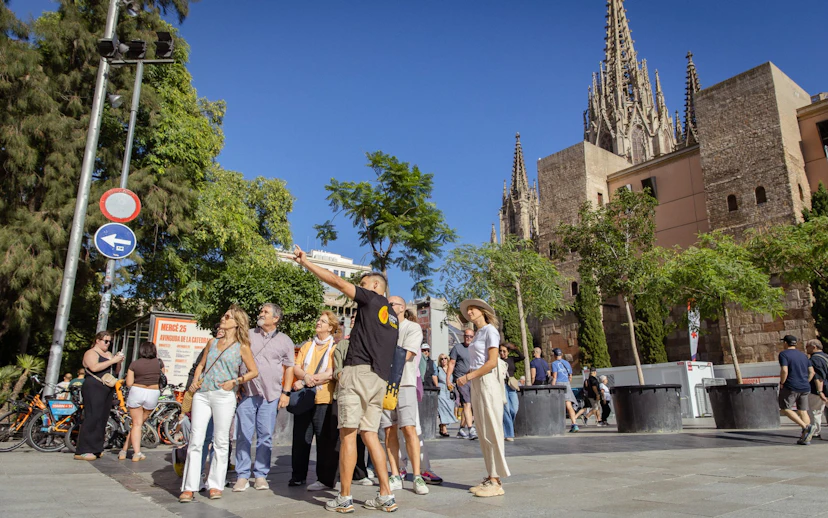
Gothic Quarter walking tour + Cathedral entry | Guided walking tour + Cathedral entry + Gothic Quarter context | A short Barcelona stay where you want the cathedral to make sense within the wider old city | From €30 |
Early-access Cathedral tour + rooftop | Before-hours entry + guided visit + rooftop access | A crowd-free visit where quiet atmosphere and clear photos matter more than the lowest price | From €45 |
How do you get around Barcelona Cathedral?
Getting around Barcelona Cathedral
Barcelona Cathedral is best explored on foot and is manageable in 45–60 minutes, or about 75–90 minutes if you include the rooftop and audioguide. The main nave is directly ahead from the entrance, while the cloister and chapter house sit off to the side and are the areas most often missed on a quick lap.
- Nave and high altar → Gothic vaults, choir, and access toward the crypt area → allow 15–20 minutes.
- Cloister → geese, fountain, and quieter arcades → allow 15–20 minutes.
- Chapter house museum → smaller art collection and the Desplà Pietà context → allow 10–15 minutes.
- Chapel of the Holy Christ of Lepanto → leaning crucifix and one of the cathedral’s strongest legends → allow 5–10 minutes.
- Rooftop terraces → skyline views, spires, and stone details → allow 15–20 minutes.
Suggested route: Start with the nave and choir before the central aisle fills up, move next to the crypt and side chapels, then slow down in the cloister and chapter house, and finish on the rooftop before the elevator queue grows.
Maps and navigation tools
- Map: Digital visit map via the cathedral’s virtual guide → covers the main spaces and stop order → load it on your phone before you start.
- Signage: Good enough for the main route, but not good enough to reliably catch the chapter house or Lepanto chapel without checking the guide.
- Audio guide / app: Included with admission in multiple languages → accessed on your own smartphone → worth using because it explains the geese, heraldry, and saint legends that signage barely covers.
💡 Pro tip: Download the virtual guide before you begin — thick stone walls and uneven signal make it much easier to set up near the entrance than halfway through the visit.
What are the most significant spaces in Barcelona Cathedral?

Grand façade and gargoyles
Attribute — Era: Neo-Gothic façade completed in the late 19th and early 20th centuries
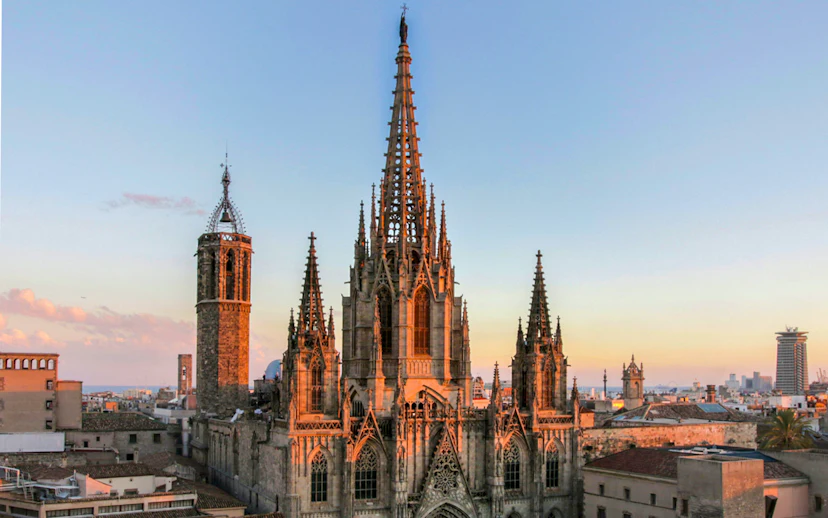
The façade is the image most people associate with the cathedral, but it’s more interesting once you know it isn’t medieval in the same way the interior is. Slow down for the stonework above the central portal and the line of gargoyles along the upper edges — many visitors photograph the whole front and miss the details. Evening light makes the carvings stand out especially well.
Where to find it: Main west front on Pla de la Seu, before you enter.
Cloister of the geese
Attribute — Era: Gothic cloister with a long-standing symbolic tradition
This is the part that changes the visit from a quick church stop into something more memorable. The garden courtyard feels unusually calm for central Barcelona, and the 13 white geese tie directly to Saint Eulalia’s martyrdom at age 13. Most visitors notice the birds, but rush past the vaulted walkways, fountain, and quieter corners that make the cloister feel separate from the city outside.
Where to find it: Through the cloister access inside the cathedral visitor route, off the main interior.
Crypt of Saint Eulalia
Attribute — Significance: Burial place of Barcelona’s co-patron saint
The crypt is one of the cathedral’s spiritual centers and easy to treat as just another stop if you’re moving too fast. It sits beneath the main altar and holds Saint Eulalia’s alabaster sarcophagus in a much quieter, more devotional setting than the nave above. What many visitors miss is the shift in atmosphere here — this is not just art to look at, but a space still used for prayer and reverence.
Where to find it: Beneath the high altar, reached from the central interior route.
Choir stalls
Attribute — Craft: 15th-century carved woodwork with heraldic decoration
The choir is one of the cathedral’s richest historical spaces, especially if you care about political and religious history as much as architecture. The carved stalls and heraldic shields connect the cathedral to the Order of the Golden Fleece ceremony of 1519, but most visitors only glance at the enclosure and move on. Look closely at the coats of arms and the carving depth rather than treating it as background furniture.
Where to find it: In the center of the nave, enclosed within the main interior.
Chapel of the Holy Christ of Lepanto
Attribute — Legend: Historic crucifix tied to the Battle of Lepanto
This chapel matters less for scale than for story. The crucifix is famous for its noticeable lean, which tradition links to dodging a cannonball during the 1571 battle. Many people enter the chapel, lower their eyes, and leave; the easy-to-miss detail is that the crucifix sits high, so you need to look up to really see what makes it different.
Where to find it: Along the right side of the nave in the Chapel of the Holy Sacrament.
Rooftop terraces
Attribute — Experience type: Elevated viewpoint and architectural access
The rooftop is what makes the ticket feel fuller than a standard church visit. You get views across the Gothic Quarter, glimpses toward landmarks like Sagrada Família, and a close look at spires, buttresses, and rooftop stonework most visitors never notice from below. What people often miss is that this is also one of the best places to understand how the cathedral sits inside the old city grid.
Where to find it: Via the elevator in the cathedral visitor route, usually toward the end of the visit.
Facilities and accessibility
- 🚻 Restrooms: Visitor restrooms are available near the cloister, so you won’t need to leave the cathedral route to use them.
- 🛍️ Gift shop / merchandise: The small shop near the exit sells postcards, rosaries, and religious souvenirs, and it’s the easiest place to pick up a simple keepsake rather than something bulky.
- 🪑 Seating / rest areas: Seating is available in the nave and around quieter parts of the cloister, which helps if you want to pause between the interior and rooftop sections.
- ♿ Mobility: There is a step-free side entrance and an elevator to the rooftop, but parts of the experience still feel medieval — cobbled approaches, tighter chapel areas, and some sections around the choir are less easy to navigate.
- 👁️ Visual impairments: The included audioguide adds useful context for the route and major highlights, but the visit is still heavily visual and no dedicated tactile route is a major part of the experience.
- 🧠 Cognitive and sensory needs: The calmest window is right after opening on a weekday, while noon in summer is much louder and more crowded in the nave, cloister, and elevator area.
- 👨👩👧 Families and strollers: The main route is manageable with a compact stroller, though the older paving outside and some tighter side spaces make a lighter setup easier than a large stroller.
Barcelona Cathedral works best for children if you keep the visit short, focus on the geese and rooftop, and treat it as a 45-minute story-filled stop rather than a full museum session.
- 🕐 Time: About 45–60 minutes is realistic with younger children, especially if you prioritize the cloister, geese, and rooftop instead of every side chapel.
- 🏠 Facilities: Restrooms near the cloister make it easier to pause before or after the rooftop section, which is usually the part children enjoy most.
- 💡 Engagement: Use the geese and Saint Eulalia story as your running thread, because it gives children one clear thing to look for through the whole visit.
- 🎒 Logistics: Bring a small bag, a light layer that covers shoulders if needed, and arrive early before the nave gets crowded and patience runs out.
- 📍 After your visit: Plaça Nova just outside is an easy reset point, with open space, street activity, and room for a quick snack break.
Rules and restrictions
What you need to know before you go
- Cultural visits require a paid ticket, while free entry windows are for worship only, and you should carry ID if you’re using a reduced or free category.
- Large luggage isn’t allowed, and there are no on-site lockers, so arrive with a small day bag.
- Tickets are single-entry, so once you leave you’ll need to queue again if you want to come back in.
Not allowed
- 🚫 Food and drink aren’t part of the visitor route, so plan coffee or snacks before or after your visit.
- 🚬 Smoking and vaping aren’t allowed inside the cathedral.
- 🐾 Pets aren’t allowed inside, except service animals.
- 🖐️ Touching artworks, climbing, or leaning on historic structures is prohibited because this is both an active church and a fragile heritage site.
Photography
Photography is generally allowed in the main cathedral and cloister if you keep it respectful and don’t use flash, but restrictions are tighter in sacred spaces such as the crypt and parts of the Lepanto chapel, and during Mass. Don’t assume the same rule applies everywhere. If staff ask you to stop in a devotional area, do so immediately.
Dress code
Barcelona Cathedral enforces a dress code for entry. Entry can be refused if the requirements below are not met.
Required:
- Shoulders covered
- Knees covered
- Hats removed inside sacred spaces
Good to know: If you arrive underprepared, cover-ups may be sold near the entrance, which is an avoidable extra cost if you bring a scarf or light layer.
⚠️ Dress code is enforced at the entrance with no exceptions. Bare shoulders and short bottoms are the most common reasons visitors get caught out, and a light scarf is the easiest fix.
Good to know
- Free-entry worship hours are not the same as a free full visit, so don’t expect normal tourist access to the roof, cloister, and museum spaces.
- The included audioguide works on your own phone, so low battery or poor signal can make an otherwise straightforward visit more frustrating.
Practical tips
- Book one to three days ahead in summer if you want a smooth morning visit, because the cathedral rarely sells out weeks out, but midday lines and rooftop waits build fast on weekends.
- If you’re even 15–20 minutes late, the issue usually isn’t the ticket itself but losing the quietest part of the day — by then the cloister, central nave, and roof queue feel completely different.
- Don’t rush the cloister after seeing the nave; most people do the reverse of what works best here, spending too long on the first photo stop and then cutting the most atmospheric section short.
- Do the rooftop before noon if you care about flow. The elevator is small, and that short queue feels longer once tour groups stack up behind you.
- Bring your own headphones and start the audioguide near the entrance, because phone signal can weaken inside the stone structure and troubleshooting it halfway through wastes more time than people expect.
- Wear something that already meets the dress code instead of relying on a cover-up at the door. It saves money, avoids awkward delays, and means you won’t be the one reorganizing your outfit in the queue.
- Eat before or after, not between sections. There’s no café inside, and once you’ve stepped out for lunch you’ll lose your place in the rhythm of the visit and may need to queue again.
What else is worth visiting nearby?
Commonly paired: Picasso Museum
Picasso Museum
Distance: 700m — 8–10 minutes on foot
Why people combine them: Both sit in the old city, and the pairing gives you a strong half-day contrast between Gothic Barcelona and one of its best art museums.
Commonly paired: Palau de la Música Catalana
Palau de la Música Catalana
Distance: 400m — 5 minutes on foot
Why people combine them: It’s one of the easiest same-day architecture pairings in central Barcelona, moving from medieval Gothic to full Catalan Modernisme without losing time in transit.
Also nearby
Santa Maria del Mar
Distance: 800m — 10 minutes on foot
Worth knowing: If you want another Gothic church after the cathedral, this is the clearest comparison point — simpler, more local in feel, and easier to do quickly.
MUHBA Plaça del Rei
Distance: 250m — 3 minutes on foot
Worth knowing: It gives useful Roman and medieval context to the ground the cathedral stands on, so it’s especially worth adding if the history matters more to you than another big-name sight.
Eat, shop and stay near Barcelona Cathedral
- On-site: There isn’t a café inside Barcelona Cathedral, so nearby bars and bakeries in the Gothic Quarter are your real food plan rather than a post-visit extra.
- Bilbao Berria (1-minute walk, Plaça Nova 3): Pintxos and small plates, $$, and one of the easiest no-detour stops right after you leave the square.
- Caelum (4-minute walk, Carrer de la Palla 8): Cakes, coffee, and light lunch options, $$, and a good quieter reset after a crowded midday visit.
- 4 Gats (6-minute walk, Carrer de Montsió 3): Catalan classics and a historic dining room, $$$, best when you want atmosphere and have time to sit down.
- Pro tip: Eat before 12 noon or after 2:30pm if you’re visiting in peak season, because the nearby Gothic Quarter lunch rush can take almost as long as the cathedral queue.
- Cathedral gift shop: Religious souvenirs, postcards, and small keepsakes, located by the exit and best for something quick rather than a serious shopping stop.
- Portal de l’Àngel: Big-brand shopping street a short walk away, useful if you want practical city-center shopping immediately after your visit.
- La Manual Alpargatera: Traditional espadrilles and Barcelona-made footwear, about 8–10 minutes away, worth it if you want something more local than standard souvenir stock.
The Gothic Quarter is one of the most atmospheric bases in Barcelona if you want to step out straight into the old city and walk to major sights. It suits short stays especially well, but it isn’t the quietest or most spacious part of town, and street noise can be real at night. If you want convenience over calm, it works very well.
- Price point: Mostly mid-range to upper-mid-range, with boutique hotels and smaller rooms more common than big-value modern properties.
- Best for: A short city break where you want to walk to the cathedral, El Born, Las Ramblas, and central sights with minimal transport planning.
- Consider instead: Eixample if you want quieter streets, better transport connections, and often better room value, or El Born if you want old-town character with a slightly more food-and-bar-focused feel.
Frequently asked questions about visiting Barcelona Cathedral
Most visits take 45–75 minutes. If you use the audioguide properly and go up to the rooftop terraces, allow closer to 90 minutes; if you’re only doing the main interior quickly, 30–45 minutes can be enough.
No, you usually don’t need to book weeks ahead for Barcelona Cathedral. It’s still smart to book at least a day or two ahead in summer, on weekends, or if you want an early, quieter visit without waiting in the on-site line.
Yes, but mainly in summer and around noon. This isn’t Sagrada Família-level demand, yet pre-booking still helps when the entrance line reaches 20–30 minutes and the roof elevator queue is already building.
Arrive 10–15 minutes early. That gives you time for the dress-code check, security, and getting the virtual audioguide working before you enter the nave.
Yes, you can bring a small bag or backpack. Large luggage isn’t allowed, and there are no lockers on-site, so this is not a place to arrive straight from the airport with rolling bags.
Yes, photography is usually allowed in the main spaces if you’re respectful and don’t use flash. Rules are stricter in sacred areas such as the crypt and some chapels, and photography should stop during Mass or whenever staff request it.
Yes, group visits are common. If you’re coming with a larger group, an early slot or a guided visit works better than simply arriving at peak time, because the nave and cloister get congested quickly once tour groups stack up.
Yes, as long as you keep expectations realistic. The geese in the cloister, the rooftop, and the legends around Saint Eulalia make it more engaging than a standard church visit, but most families are happiest keeping the visit to about an hour.
Barcelona Cathedral is partly wheelchair accessible. There is a step-free side entrance and an elevator to the rooftop, but some older areas, tighter passages, and the cobbled approaches around the cathedral can still make the visit uneven.
Food is available near Barcelona Cathedral, but not as part of the actual visit. There’s no on-site café, so plan to eat in the surrounding Gothic Quarter before or after entering.
Shoulders and knees should be covered, and hats should come off inside. Enforcement is real rather than symbolic, so arriving in beachwear or very short clothing can mean being stopped at the entrance or having to buy a cover-up.
Yes, but only during worship access hours, not as a free version of the full tourist ticket. If you want the cloister, rooftop, choir, and museum spaces, you need the cultural visit ticket rather than the prayer-only window.