Museu Tàpies visitor guide
The Museu Tàpies is a compact Barcelona museum best known for Antoni Tàpies’s textured paintings, sculptures, and the rooftop Núvol i Cadira sculpture that crowns the building. The visit is quieter and more contemplative than the city’s blockbuster museums, but it rewards slowing down rather than rushing for headline works. The biggest difference between a flat visit and a strong one is giving equal time to the building, the permanent collection, and the temporary show. This guide covers timing, tickets, route, and what not to miss.
Quick overview: Museu Tàpies at a glance
If you want the short version before you book, here’s what actually changes the visit.
- When to visit: Midweek late mornings are usually calmer than Saturday afternoons, and that matters more here because the museum is compact and even modest crowds can make the galleries feel busier.
- Getting in: From €12 for standard entry, or from €38 with the Articket BCN pass. Advance booking helps most on spring and summer weekends, but same-day entry is often still realistic because this is a smaller museum.
- How long to allow: 1–2 hours for most visitors. Add time if you want to read labels closely, use a guide, or spend properly in the temporary exhibition upstairs.
- What most people miss: The rooftop Núvol i Cadira sculpture from the street, the building’s light-filled modernist interior, and the temporary exhibition galleries that give the visit more range than many people expect.
- Is a guide worth it? Yes, if Tàpies’s symbols and materials feel hard to decode on your own; otherwise, a short self-guided visit works well because the museum is manageable in size.
Jump to what you need
🕒 Where and when to go
🗓️ How much time do you need?
🎟️ Which ticket is right for you?
🗺️ Getting around
♿ Facilities and accessibility
Where and when to go
How do you get to Museu Tàpies?
Museu Tàpies is in central Eixample, just off Passeig de Gràcia, and easy to combine with other modernist stops in the neighborhood.
Carrer d’Aragó, 255, 08007 Barcelona, Spain
- Bus: Lines 7, 22, 24, 39, 47, 63, 67, B24, H10, V15, and V17 stop within a short walk of the museum.
- Metro: Central Eixample stations near Passeig de Gràcia give you the easiest approach if you’re already sightseeing in this part of Barcelona.
- Taxi/rideshare: Drop-off on Carrer d’Aragó is the simplest option if you want the least walking.
Which entrance should you use?
The museum uses one main street entrance, and the mistake most people make is focusing on the roof sculpture and walking past the door too quickly.
- Main entrance: Located on Carrer d’Aragó. Expect little to no wait on most weekdays, and slightly longer waits on busy summer weekends or around temporary exhibition openings.
When is Museu Tàpies open?
- When is it busiest? Summer weekends, late afternoons, and temporary exhibition periods feel busier because the building is compact and many visitors pair it with Passeig de Gràcia sightseeing.
- When should you actually go? Tuesday to Thursday in the late morning usually gives you the quietest galleries and the best chance to look slowly at the surface-heavy works.
How much time do you need?
| Visit type | Route | Duration | Walking distance | What you get |
|---|---|---|---|---|
Highlights only | Entrance and building highlights → key permanent collection rooms → exit | 1 hour | 0.5 km | Covers the headline works and the building’s character, but you’ll move quickly and may skim the temporary show. |
Balanced visit | Building and orientation spaces → permanent collection → upper temporary exhibition galleries → exit | 1–2 hours | 0.8 km | Gives you enough time for the permanent collection, the building itself, and the temporary exhibition without rushing. |
Full exploration | Exterior sculpture and façade → building interiors → permanent collection → upper galleries → multimedia space and shop | 2+ hours | 1 km | Best if you want to read labels closely, use an audio guide, and spend properly with the upper-floor exhibition as well as the core Tàpies rooms. |
Which Museu Tàpies ticket is best for you
| Ticket type | What's included | Best for | Price range |
|---|---|---|---|
General admission | Museum entry + permanent collection + temporary exhibitions on show | A straightforward self-guided visit where you want the full museum without extra layers. | From €12 |
How do you get around Museu Tàpies?
Gallery layout
Museu Tàpies is compact rather than sprawling, with a clear museum route that’s easy to self-navigate. What matters more than navigation is pacing, if you move too fast, the building and the temporary exhibition can feel like side notes when they’re actually part of the draw.
- Entry and orientation spaces: Introductory context on Tàpies and the building + first impressions of the museum’s architecture → allow 15–20 min.
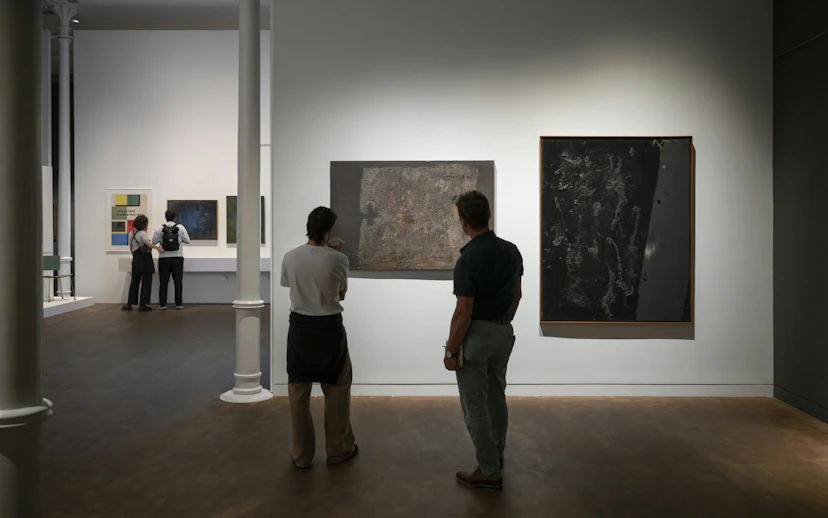
- Permanent collection galleries: Mixed-media paintings, assemblages, and key works from across Tàpies’s career → allow 30–45 min.
- Upper galleries: Temporary exhibitions and changing contemporary programming → allow 20–40 min.
- Exit area: Bookshop and multimedia space → allow 10–15 min if you want to browse catalogues or decompress before leaving.
Suggested route: Start with the building and orientation spaces, then do the permanent collection before heading upstairs to the temporary show; many visitors do the reverse and end up rushing the core Tàpies rooms.
Maps and navigation tools
- Map: Omit a downloaded map if you’re keeping the visit simple; the museum is compact enough to navigate without one.
- Signage: Wayfinding is usually manageable because the museum is compact, but the route can feel less obvious when temporary exhibitions reconfigure upper-floor spaces.
- Audio guide / app: Audio guidance is worth it here more than at many small museums because Tàpies’s symbols and materials aren’t always self-explanatory from a quick glance alone.
💡 Pro tip: Look at the roof sculpture before you enter, then look for it again from inside if you can. The museum makes more sense when you treat the building and collection as one experience.
Where are the masterpieces inside Museu Tàpies?

Núvol i Cadira
Artist: Antoni Tàpies
This stainless-steel sculpture is the museum’s first statement, and it’s worth slowing down for before you even step inside. The giant cloud and bent chair feel playful at first, but they also frame the whole museum’s interest in ordinary objects turned symbolic. Most visitors photograph it quickly from street level and move on without noticing how decisively it changes the building’s skyline.
Where to find it: On the museum façade, crowning the roofline above the main entrance.
Montaner i Simón building
Architect: Lluís Domènech i Montaner
The building is one of the museum’s real highlights, not just a container for the collection. Its brick, iron, and light-filled interior give Tàpies’s rough surfaces a setting that feels unexpectedly right. What many visitors miss is how much of the experience comes from this contrast between a 19th-century publishing house and a late-20th-century contemporary art institution.
Where to find it: Start outside on Carrer d’Aragó, then keep looking up and around as you move through the entry and courtyard spaces.
Material paintings
Era: 1960s–1980s
These are the works that explain why Tàpies matters: heavy surfaces, embedded materials, and signs that sit somewhere between painting, object, and wall. They can feel austere if you rush, but they’re far richer when you get close enough to notice cracks, dust-like textures, and scratched marks. Most people scan them as abstract works when they’re really about matter, scale, and tension.
Where to find it: In the main permanent collection galleries at the heart of the museum route.
Llibre
Artist: Antoni Tàpies, 1987
This bronze sculpture is a good reminder that Tàpies was never only a painter. Its subject looks simple, but the transformation of a familiar object into something weighty and symbolic is exactly what makes his work so distinctive. Visitors often remember the larger canvases and miss how much the sculptural works sharpen the ideas running through the whole museum.
Where to find it: In the permanent collection spaces among the later works and sculptural displays.
Temporary exhibition galleries
Creator: Rotating contemporary artists and themed Tàpies shows
These rooms are the part most likely to change your impression of the museum, especially if you expect it to be only a fixed single-artist collection. The rotating program keeps the visit from feeling static and often creates a useful dialogue with Tàpies’s material, political, or spatial concerns. Many people underestimate this floor, but it’s what makes repeat visits worthwhile.
Where to find it: In the upper galleries, after the core permanent collection rooms.
Facilities and accessibility
- 🛍️ Gift shop / merchandise: The museum shop near the end of the visit stocks exhibition catalogues, books on Antoni Tàpies, prints, and art-focused gifts rather than generic souvenirs.
- 🍽️ Café: There isn’t a full café on-site, so this works better as a pre-lunch or post-lunch cultural stop than a place to break for a meal.
- 🪑 Seating / rest areas: A few benches give you space to pause, reflect, or wait before leaving, which suits the museum’s quieter pace.
- 🎥 Multimedia space: A small multimedia area adds context to Tàpies’s work and is useful if you want a short recap before you exit.
- 🏛️ Courtyard / interior views: Part of the visit’s appeal is the building itself, so don’t treat the shared architectural spaces as just corridors between galleries.
- ♿ Mobility: The museum is fully wheelchair accessible, and its relatively compact layout makes a self-paced visit easier than at larger multi-wing museums.
- 👁️ Visual impairments: Guided visits are the most useful option here because Tàpies’s work relies heavily on texture, material, and symbolism that benefit from verbal explanation.
- 🧠 Cognitive and sensory needs: Midweek late mornings are the least overwhelming time to visit, since the smaller galleries can feel noticeably busier once afternoon sightseeing traffic builds.
- 👨👩👧 Families and strollers: The route is manageable in length for strollers and short visits, though the collection is better suited to older children and teens than to very young kids.
This museum suits older children, teens, and visually curious kids best, especially if they already enjoy drawing, texture, or unusual materials in art.
- 🕐 Time: Around 45–90 min is realistic with children, and the exterior sculpture plus a short run through the permanent collection works better than trying to linger in every room.
- 🏠 Facilities: The museum’s smaller scale helps families because there’s less walking and fewer transitions than at Barcelona’s larger museums.
- 💡 Engagement: Start with Núvol i Cadira outside and ask children to spot everyday objects turned into art before you go inside.
- 🎒 Logistics: Bring snacks for afterward rather than during the visit, and aim for a quieter late-morning slot if you want more space to talk in front of the works.
- 📍 After your visit: The Passeig de Gràcia area nearby gives you an easy next stop if children need open-air walking and a change of scene after the galleries.
Rules and restrictions
What you need to know before you go
- Entry requirement: General admission is €12, reduced admission is €8, children up to the age of 16 enter free, and group guided visits are booked separately.
Not allowed
- 🚫 Food and drink: There isn’t a full café on-site, so plan to eat before or after your visit rather than expecting a meal break inside.
- 🖐️ Touching works: Don’t touch the artworks, even when the textured surfaces feel tactile, because material conservation is a major part of the museum’s work.
Photography
- Photography rules can vary between the permanent collection and temporary exhibitions, so check room signage before you shoot. At a museum like this, the stricter rules usually affect temporary loans more than the building or exterior sculpture.
- If you want the safest approach, assume flash, tripods, and selfie sticks will be more restricted than casual phone photography.
Good to know
- Look up before entering: The rooftop Núvol i Cadira sculpture is part of the experience, and many visitors only properly notice it after they’ve already left.
- Don’t skip the upper floor: The temporary exhibition is where the museum feels most current, and it’s the section most often rushed.
Practical tips
- Booking and arrival: Book 1–3 days ahead if you’re visiting in July or August, or if you want to pair this with a packed Passeig de Gràcia day; it’s usually easier to book than Barcelona’s biggest museums, but weekend demand still rises first.
- Pacing: Save at least 20–30 min for the temporary exhibition upstairs, because many visitors spend everything on the permanent rooms and then skim the one section that changes most often.
- Crowd management: Tuesday to Thursday late mornings are the sweet spot here, because the museum stays quieter before the heavier afternoon flow from nearby Eixample sightseeing.
- What to bring or leave behind: Bring headphones if you’re using an audio guide, and skip bulky bags or extra shopping if you can — this is a compact museum where slow looking is easier when you’re carrying less.
- Food and drink: Eat before you enter or plan lunch afterward, because there isn’t a full café on-site and most visits wrap in 1–2 hours anyway.
- Mindset: This is not a ‘walk fast and photograph everything’ museum; if Tàpies feels difficult at first, stay with one or two works for a full minute and the visit usually clicks much better.
What else is worth visiting nearby?
Commonly paired: Casa Milà
Distance: 1 block, around a 5-min walk
Why people combine them: Both reward visitors who care about art, design, and architecture, and they fit naturally into the same Eixample walk without adding transit time.
Commonly paired: Fundació Joan Miró
Distance: 4 kms away, 10 mins via car
Why people combine them: They make a strong same-day contrast—Miró for color and surreal lightness, Tàpies for texture, matter, and post-war intensity.
Also nearby
Museu Picasso
Distance: 3.2 kms
Worth knowing: If you want a broader Barcelona art day, this is the most obvious follow-up, though it usually feels busier and more crowded than Museu Tàpies.
MACBA
Distance: 1.8 kms
Worth knowing: This is the better add-on if you want to keep the day focused on modern and contemporary art rather than pivoting into a more historical artist museum.
Eat, shop and stay near Museu Tàpies
- On-site: There isn’t a full café on-site, so the museum is best treated as a cultural stop between meals rather than a place to eat.
- Better options nearby: Information unavailable
- Pro tip: Visit in the late morning, then eat afterward — the museum is short enough that you don’t need to build a meal stop into the middle of the visit.
- Museu Tàpies shop: The museum’s own shop is the most relevant stop if you want exhibition catalogues, Tàpies books, or art-led gifts tied directly to the collection.
- Passeig de Gràcia: The nearby avenue is the practical next stop if you want broader Barcelona shopping after the museum rather than only art merchandise.
Yes, if you want a central Barcelona base with easy walking access to architecture, shopping, and several cultural stops. Eixample is more practical than atmospheric, but that practicality works well for short city breaks. If your goal is to walk out of your hotel and slot the museum into a bigger sightseeing day, this is a strong area to stay in.
- Price point: The area skews mid-range to high-end, especially close to Passeig de Gràcia, though you’ll still find more reasonable options a few streets back.
- Best for: Visitors on a short trip who want a central, walkable base and don’t want to waste time crossing the city between sights.
- Consider instead: The Gothic Quarter works better if you want older streets and a more historic feel, while Gràcia can suit longer stays if you want a less polished, more neighborhood-style base.
Frequently asked questions about visiting Museu Tàpies
Most visits take 1–2 hours. That’s enough time for the permanent collection, the building itself, and the temporary exhibition, though guided groups usually take around 75–90 min with a more structured pace.
No, you usually don’t need to book far ahead, but it helps on summer weekends and around temporary exhibition openings. This is a smaller museum with lighter demand than Barcelona’s blockbuster sights, so same-day entry is often still possible.
Arrive about 10–15 min early. That gives you enough time to find the entrance, look properly at the rooftop sculpture, and start on time without turning a short museum visit into a rushed one.
A small bag is the safest option for a visit like this. If you’re carrying bulky bags, store them elsewhere before you arrive so you can move more comfortably through the compact galleries.
Photography rules can vary, especially between the permanent collection and temporary exhibitions. Check room signage first, and assume flash, tripods, and selfie sticks are more likely to be restricted than casual phone photography.
Yes, group visits are available, and guided tours typically run around 75–90 min. They’re a strong option here because Tàpies’s work becomes much easier to read with someone explaining the symbols, materials, and context.
Yes, but it suits older children and teens better than very young kids. The small size helps families, and the rooftop sculpture plus the rough materials in the collection give children something concrete to latch onto.
Yes, the museum is fully wheelchair accessible. Its compact footprint also makes it easier to manage than larger museums where long corridors and multiple wings turn into part of the challenge.
Don’t miss the building, the rooftop Núvol i Cadira sculpture, and the temporary exhibition upstairs. Many visitors focus only on the permanent Tàpies rooms, but the visit feels fuller when you treat architecture and changing exhibitions as part of the main experience.