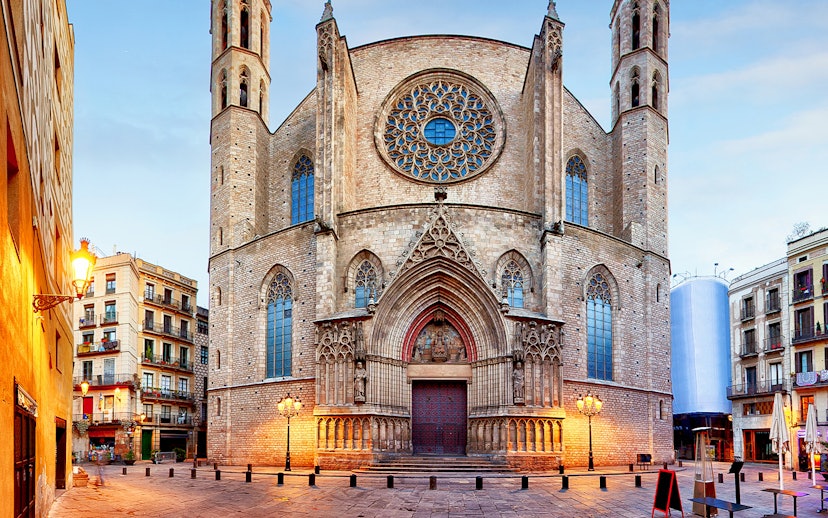
Santa Maria del Mar visitor guide
Santa Maria del Mar is a working basilica in Barcelona best known for its pure Catalan Gothic interior, rooftop terraces, and unusually light-filled nave. The visit itself is compact, but it feels richer if you slow down and look up rather than rush straight to the roof. Timing matters more than distance here, because worship hours and guided-access windows can shape what you see. This guide helps you plan entry, timing, route, and the spaces worth prioritizing.
Quick overview: Santa Maria del Mar at a glance
This is a short visit on paper, but the difference between a quick walkthrough and a rewarding one comes down to timing, access, and knowing what not to miss.
- When to visit: Visitor access runs daily around worship and cultural-visit hours; late weekday mornings usually feel calmer than Sundays and weekend late mornings because services and neighborhood foot traffic both peak then.
- Getting in: The available Headout option is a guided Skip-the-Line Guided Tour of Santa Maria del Mar Interior, and booking ahead is the safer choice in spring, summer, and on weekends if you want rooftop access at a specific time.
- How long to allow: 45–90 minutes works for most visitors, but it stretches closer to 2 hours if you do the rooftop terraces, pause for photos, and spend time on the crypt and side details.
- What most people miss: The crypts below the altar, the Window of the Ascension, and the lavabo are easy to skip if you treat the church as a quick photo stop.
- Is a guide worth it? Yes, if you want rooftop access and context on the basilica’s layout, symbols, and Gothic details; no, if you only want a short interior stop and are happy to move at your own pace.
Jump to what you need
Where and when to go
Which Santa Maria del Mar ticket is best for you
| Ticket type | What's included | Best for | Price range |
|---|---|---|---|
Skip-the-Line Guided Tour of Santa Maria del Mar Interior | Skip-the-line admission into Santa Maria del Mar + English and Spanish-speaking tour guide + free time inside the Basilica | A first visit where you want the rooftop terraces, crypts, and Gothic details explained instead of doing a quick interior walkthrough with little context. | From €19 |
How do you get around Santa Maria del Mar?
Santa Maria del Mar is compact and best explored on foot in 45–90 minutes, but the visit is vertical enough that a simple route helps. The main focal point sits straight ahead as soon as you enter, with the widest interior view opening up from the center of the nave.
- Main nave: The signature forest of columns and long Gothic sightline → spend 15–20 minutes here before climbing anywhere.
- Altar and crypt area: The spiritual center of the basilica, with crypt access depending on the visit type → spend 10–15 minutes.
- Rooftop terraces: Panoramic views over El Born and central Barcelona → spend 15–20 minutes, longer if you want photos.
- Side details: The rose window, Window of the Ascension, and smaller architectural features → spend 10–15 minutes if you do not want the visit to feel incomplete.
Suggested route: Start in the middle of the nave, then move toward the altar and crypt details before going up to the terraces; most visitors reverse this, which means they rush the quieter interior details after the best views are already behind them.
What are the most significant spaces in Santa Maria del Mar?

The nave
Era: 14th-century Catalan Gothic
This is the space Santa Maria del Mar is really known for: tall, evenly spaced columns, a broad uninterrupted interior, and an unusual feeling of lightness for a Gothic church. Most visitors look once, take a photo, and move on too quickly. What they miss is how clean and balanced the geometry feels when you stop at the center aisle and look from floor level instead of only upward.
Where to find it: Directly ahead from the main entrance, best viewed from the middle of the central aisle.
Rooftop terraces
Type: Rooftop viewpoint
The rooftop terraces give you one of the clearest ways to understand where the basilica sits within El Born and the wider old city. The appeal is not just the skyline, but the contrast between the heavy stone exterior and the open air above it. Many visitors focus only on the broad city view and miss the close-up look at the church’s buttresses, roofline, and structural details.
Where to find it: Access is via the upper visitor route included with guided rooftop visits.
Crypts below the altar
Type: Sacred lower-level space
The crypts add a quieter, more intimate layer to the visit and help the basilica feel like more than a beautiful shell. They are easy to undervalue because the nave is so visually immediate, but this is where the mood shifts from architectural admiration to religious history. Visitors often spend too little time here because they are already thinking about the rooftop climb.
Where to find it: Below the altar area, accessed as part of the guided route when included.
Rose window
Type: Stained-glass feature
The rose window is one of the interior details that rewards a second look, especially when the light is good. It is easy to register it as ‘the big window at the back’ and keep moving, but the scale, color, and symmetry are part of what balances the basilica’s otherwise restrained stone interior. The best view is not right underneath it, but slightly farther down the nave.
Where to find it: On the inner wall above the entrance end of the basilica.
Window of the Ascension and the lavabo
Type: Architectural details
These are exactly the kinds of details that separate a rushed visit from a satisfying one. They do not dominate the space, so visitors heading straight for the roof or the altar often walk past them without realizing what they are seeing. Slow down here and the basilica feels far more layered than a simple one-room church.
Where to find it: Along the interior side areas off the main visitor path, best seen after you’ve taken in the nave.
Facilities and accessibility
- 🎟️ Ticket check-in: Guided visits and cultural-entry checks are handled before you enter the main basilica route.
- 🪑 Seating: The nave has pew seating, which makes it easier to pause without leaving the main viewing area.
- ⛪ Worship space: This is an active basilica, so visitor flow can change around Masses and religious services.
- 🌤️ Rooftop access: The terrace portion is weather-dependent and can be more restricted than the main interior route.
- 👥 Guided visit support: An English and Spanish-speaking guide is available on the Headout tour, which helps with orientation in a short visit.
- 🍽️ Cafe / restaurant / food stalls: Not applicable inside the basilica itself.
- ♿ Mobility: The main floor is more manageable than the upper sections, but rooftop access involves stairs and is not a fully step-free route.
- 👁️ Visual impairments: The strongest part of the visit is spatial and architectural, so a guided explanation adds more value than a quick self-guided pass.
- 🧠 Cognitive and sensory needs: Weekday late mornings are usually calmer than Sundays, when worship and neighborhood traffic can make the visit feel less predictable.
- 👨👩👧 Families and strollers: The nave is easier with a stroller than the rooftop route, so families should treat the upper section as the less flexible part of the visit.
- 🔇 Quiet environment: Outside service times, the basilica is generally calmer than busier central landmarks, but silence and respectful behavior are expected.
Santa Maria del Mar works best for children who can handle a quiet, slower-paced visit and are interested in views, architecture, or climbing to the rooftop.
- 🕐 Time: 30–45 minutes is realistic with younger children, while older children usually manage the full 60–90-minute visit better.
- 🏠 Facilities: The main advantage for families is the compact layout, because you are never far from the exit or from a seated pause in the nave.
- 💡 Engagement: Turn the visit into a ‘find the details’ game by asking children to spot the rose window, the tallest columns, and the city landmarks from the roof.
- 🎒 Logistics: Bring a light bag, skip bulky strollers if you plan to go up, and choose a weekday slot so the church feels less crowded and more manageable.
- 📍 After your visit: Passeig del Born is close for a relaxed snack break and gives children a change of pace right after the quiet interior.
Know before you go
Practical tips
- Book for the roof, not just the church: The interior visit is rewarding on its own, but the rooftop access is what most changes the experience, so choose a timed guided visit if you do not want to gamble on availability.
- Arrive 10–15 minutes early: This is enough buffer for ticket checks and group assembly without standing around too long in the square.
- Start by standing still in the center aisle: Most people keep moving as soon as they enter, but the nave makes the strongest impression when you stop for 2 minutes and let your eyes adjust upward.
- Save your photos for 2 moments: Take wide interior shots early, then do skyline photos from the rooftop; if you try to shoot constantly all the way through, the visit feels more rushed than it is.
- Bring a small bag and skip unnecessary layers: The visit is short, but stairs and tighter circulation make large bags more annoying here than they would be at a sprawling museum.
- Eat before or after, not between sections: There is no on-site meal stop built into the experience, and El Born has far better options once you step back outside.
- Choose a weekday if you want atmosphere without crowd pressure: Santa Maria del Mar rewards quiet looking, and that is much harder on Sunday service windows or weekend late mornings.
What else is worth visiting nearby?
Eat, shop and stay near Santa Maria del Mar
- On-site: Not applicable.
- Passeig del Born cafés (2–5-minute walk, Passeig del Born): Coffee, pastries, and light breakfasts; best if you want something quick before a morning slot.
- Carrer de l’Argenteria tapas bars (3–6-minute walk, Carrer de l’Argenteria): Tapas and drinks in the heart of the neighborhood; the easiest post-visit option if you want to stay close.
- Barceloneta waterfront restaurants (15–20-minute walk, Passeig de Joan de Borbó): Seafood and longer sit-down meals; worth it if Santa Maria del Mar is part of a bigger afternoon walk.
- 💡 Pro tip: Eat after your visit, not before, if you are doing the rooftop section — it is a short stop, and you will have better food options once you are back out in El Born.
- El Born independent shops: Design goods, jewelry, notebooks, and small gifts; useful if you want something more local than standard souvenir stalls.
- Carrer dels Flassaders boutiques: Clothing, ceramics, and small design stores; easiest to browse if you are already walking toward the Picasso Museum side of the neighborhood.
Yes, if you want a walkable old-neighborhood base with food, atmosphere, and easy access to several central sights. El Born feels livelier and more local than the busiest parts of the Gothic Quarter, but it is usually not the cheapest place to stay. It suits short city breaks well because you can cover a lot on foot.
- Price point: Mid-range to upscale overall, with better value a little farther from the busiest Born streets.
- Best for: Visitors on a short Barcelona trip who want to walk to food, culture, and old-city landmarks without relying heavily on transit.
- Consider instead: Stay in the Gothic Quarter for more classic central sightseeing, or Eixample if you want wider streets, more hotel choice, and an easier citywide transit base.
Frequently asked questions about visiting Santa Maria del Mar
Most visits take 45–90 minutes. If your ticket includes rooftop access and you like architecture or photos, it can stretch closer to 2 hours, but it is still a compact stop compared with Barcelona’s larger museums and monument complexes.
Yes, booking ahead is the safer choice if you want a guided visit or rooftop access at a specific time. A short church visit may feel spontaneous, but timed terrace capacity and weekend demand make advance booking much less stressful.
Yes, it is worth it on weekends, holidays, and busier spring and summer dates. The gain is not just a shorter wait, but a more predictable start time for a visit that can otherwise be shaped by service windows and limited rooftop access.
Arrive 10–15 minutes early. That gives you enough time for ticket checks and group organization without adding unnecessary waiting time in the square outside.
Yes, a small bag or backpack is the easiest option. Large or bulky bags make a short, vertical visit less comfortable, especially if your route includes stairs up to the rooftop terraces.
Yes, personal photography is usually fine in visitor areas if you stay respectful. Avoid flash, tripods, and intrusive shooting during worship or in quieter sacred spaces where the atmosphere matters more than getting a perfect shot.
Yes, and a guided group format works especially well here. The basilica is compact, so a guide helps keep the visit focused and makes smaller details like the crypts and architectural features easier to understand.
Yes, if your children are comfortable in quiet indoor spaces and can manage stairs if rooftop access is included. Younger children can do the main nave in 30–45 minutes, while older children usually enjoy the roof views more.
Partly. The main interior is more accessible than the rooftop route, but the upper terrace section involves stairs and is not a fully step-free experience.
Food is available nearby, but not as part of the basilica visit itself. That works well in practice because El Born has plenty of cafés and tapas bars within 2–6 minutes on foot.
There is no museum-style dress routine to plan around, but respectful clothing is the safest choice because this is an active basilica. That matters most if you are visiting around Mass or other religious services.
Yes, but sightseeing flow may change during services. If your priority is quiet viewing, photos, or rooftop access, choose a cultural-visit slot outside worship times rather than treating the church like an always-open monument.