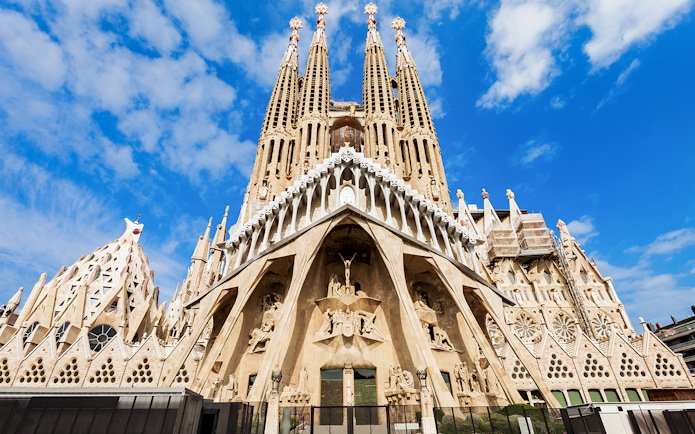
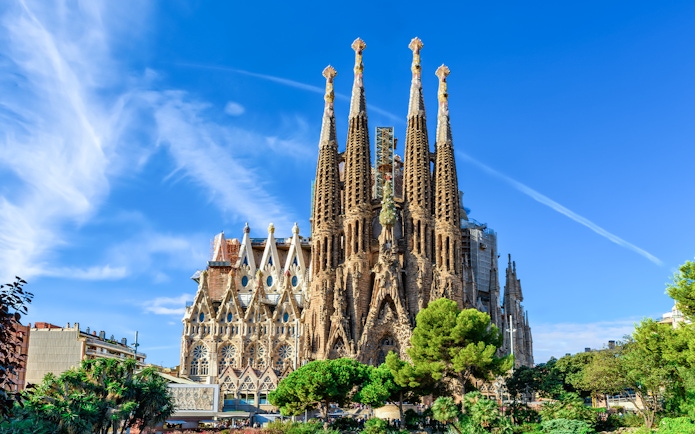
- Description — The small park opposite the basilica gives you the cleanest street-level view of the towers reflected through trees and the pond.
- Best for — Photographers, families, first-time visitors.
- Duration — 20–30 minutes.
- Combine this with — Sagrada Família – the paid interior is steps away, so you can do your exterior photos before your timed entry and avoid backtracking later. Or pair it with Avinguda de Gaudí – a few minutes on foot, which gives you a calmer continuation after the busiest photo point.
Neighborhood at a glance
- Why visit — Barcelona’s biggest concentration of Modernisme sits here, with Sagrada Família, Casa Batlló, and La Pedrera all folded into one 19th-century grid.
- Atmosphere — Ordered, broad, polished, traffic-heavy.
- Top things to do — Tour Sagrada Família, enter Casa Batlló, go up La Pedrera’s rooftop, walk Passeig de Gràcia.
- Best for — First-time visitors, architecture fans, shoppers, travelers choosing a central base.
- Time needed — 4–6 hours.
- Best time to visit — Weekday mornings in spring or autumn for shorter waits at Sagrada Família and softer light on Passeig de Gràcia.
- Nearby — Casa Milà, Casa Amatller, Rambla de Catalunya, El Nacional, Fundació Antoni Tàpies, Plaça de Catalunya.
Top things to do in Eixample
Quick navigation
🏛️ Why visit | 🎟️ Best ways to explore |🧭 Plan your visit | 🌟 Free things to do | 📋 Itinerary | 💡 Tips |🍴 Dining
Why visit Eixample

1/5
Gaudí’s major works are built into everyday streets
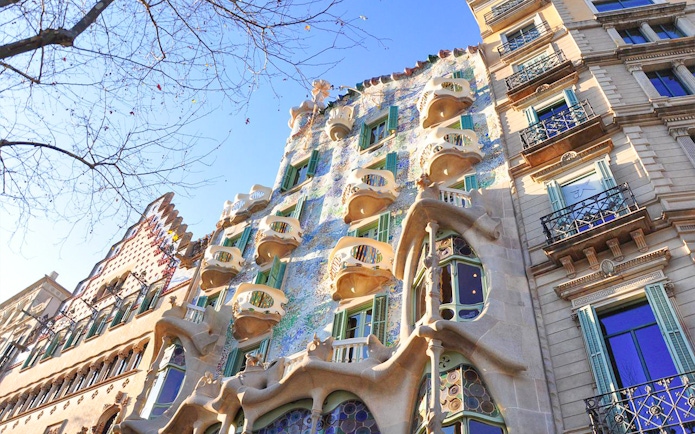
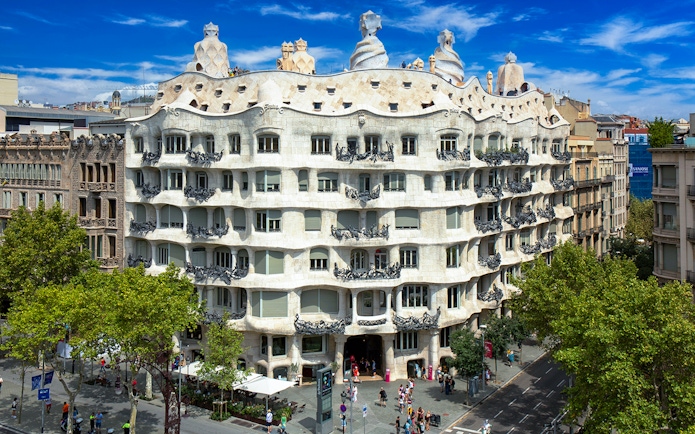
You do not need a separate “architecture day” and “city day” here. In Eixample, **Sagrada Família, Casa Batlló, and La Pedrera are part of the neighborhood’s normal street fabric, not isolated monuments. That means you can move between headline sights, cafés, shops, and hotel streets without changing districts. For first-time visitors, that makes planning much simpler.
Cerdà’s 19th-century grid still shapes how the district works
When Ildefons Cerdà laid out Eixample in the 19th century, he created broad streets, chamfered corners, and long sightlines that still define how people move through the area. You feel that history every time you cross Avinguda Diagonal, walk down Rambla de Catalunya, or look along the corners of Passeig de Gràcia. This is not accidental urban beauty; it is planned city-making. If the Gothic Quarter tells you how Barcelona began, Eixample tells you how modern Barcelona was built.
Passeig de Gràcia gives you architecture, shopping, and transport in one corridor
A lot of neighborhoods make you choose between sightseeing and practical convenience. Passeig de Gràcia does both. You can step out of the station, walk to Casa Batlló in minutes, continue to La Pedrera, and still have restaurants, metro links, and major retail all on the same axis. It is one of the easiest parts of Barcelona to use well even on a short trip.
The district changes usefully from block to block
Southern Dreta de l’Eixample around Plaça de Catalunya is busy and commercial. Around Rambla de Catalunya and Enric Granados, the pace slows into restaurant streets and terrace dining. Near Sagrada Família, the neighborhood becomes more monument-led and more residential between the tourist clusters. That variation means Eixample can suit different kinds of travelers without feeling like one-note sightseeing terrain.
It works unusually well as a base, not just a day visit
Some neighborhoods are better visited than slept in. Eixample is one of the few central Barcelona districts that does both well. You can walk to major sights, use low-friction metro connections, and still find hotel-heavy blocks that feel more functional than theatrical after dark. If you want to cover a lot of Barcelona without spending half your trip commuting, Eixample earns its keep.
Best ways to explore Eixample
A walking tour works especially well here because the district’s logic is visual. The best routes link Passeig de Gràcia, the Manzana de la Discòrdia, La Pedrera, and either finish at or begin from Sagrada Família. You are not just learning façades; you are learning how Eixample’s grid, corners, and apartment blocks were designed to be read from the street.
Food tours in Eixample tend to focus on the restaurant-heavy lanes around Rambla de Catalunya, Enric Granados, and the western side near Mercat del Ninot. This is a good district for tapas, vermouth, pastry stops, and longer seated lunches rather than grab-and-go market grazing. If you want a food-focused day without moving into older, tighter streets, Eixample is easy.
This neighborhood is built for combo tickets. Combo (Save 6%): Casa Milà + Casa Batlló Entry Tickets with Audio Guide makes obvious sense because both houses sit a short walk apart on the same boulevard. If you want a broader Gaudí day, Combo (Save 3%): Park Güell + Sagrada Familia Fast-Track Tickets also works well, since one of the city’s key Gaudí interiors is in Eixample and the other is a short ride away.
If you want something beyond daytime façade-watching, La Pedrera-Casa Milà Night Guided Tour changes the building completely with after-hours access, a rooftop light show, and cava. On the southern edge of the district, City Hall Theatre - Flamenco Show gives you an easy evening add-on near Plaça Catalunya without a cross-city detour. Eixample is one of the few Barcelona neighborhoods where daytime architecture and a clean evening plan connect this neatly.
Plan your visit
Eixample is large, but it is one of the easiest parts of Barcelona to decode. Most visitors spend their time on one of two spines: Passeig de Gràcia for the Gaudí houses, or the Sagrada Família area for the basilica and its surrounding avenues.
Most visitors arrive by Metro. If you are starting with the boulevard and Gaudí houses, use Passeig de Gràcia station and come up near Carrer d’Aragó or Gran Via; you will be 2–8 minutes from Casa Batlló and La Pedrera. If you are basilica-first, use Sagrada Família station on L2/L5, which places you directly by the monument and avoids a long first walk.
If you are coming from the airport, Aerobus Tickets: Barcelona Airport to/from Plaça Catalunya are the cleanest transfer for southern Eixample. The coaches run 24/7, serve both airport terminals, take about 35 minutes, and drop you on the district’s lower edge at Plaça de Catalunya.
Walking distances from Passeig de Gràcia station:
- Casa Batlló – 2 minutes
- La Pedrera-Casa Milà – 8 minutes
- Plaça de Catalunya – 10 minutes
- Fundació Antoni Tàpies – 5 minutes
- Sagrada Família – 25–30 minutes
Weekday mornings are the easiest time to read Eixample properly. Sagrada Família, Casa Batlló, and La Pedrera all work better before midday, while Passeig de Gràcia is more pleasant once the first shopping crowds have not yet fully built up.
- Early morning (8–10am): Best for Sagrada Família and façade shots from Plaça de Gaudí before the forecourt fills. If you are touring houses instead, this is also the calmest time to start on Passeig de Gràcia.
- Midday (11am–2pm): The busiest stretch around Sagrada Família and the commercial southern end near Plaça de Catalunya. Use this window to break for lunch on Rambla de Catalunya or Enric Granados.
- Late afternoon (4–6pm): Better light for Passeig de Gràcia façades and a cleaner walk up toward La Pedrera.
- Evening (after 6pm): The district shifts toward dining and drinks, especially around Rambla de Catalunya, Enric Granados, and Gayxample. Monument exteriors still work well for photos, but ticketed interiors begin to close out, so this is better for walking, dinner, or the Flamenco Show near Plaça Catalunya.
- The essentials — 3–4 hours for Sagrada Família, a short Passeig de Gràcia walk, and exterior views of Casa Batlló and La Pedrera.
- The ideal day — 6–7 hours for one major interior house, the basilica, a proper lunch on Rambla de Catalunya or Enric Granados, and time to walk between the key streets rather than jump on the metro.
- With guided tours — 4–6 hours if you book a Sagrada Familia Fast-Track Guided Tour and pair it with either La Pedrera-Casa Milà or Casa Batlló.
- Sagrada Família: Step-free access to the main basilica and museum; wheelchair access is available throughout the core visit. The towers are not wheelchair accessible.
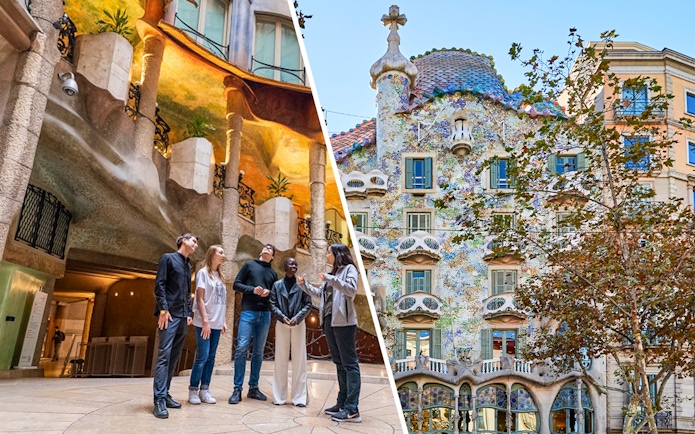
- Casa Batlló: The experience is accessible for wheelchair users. This is one of the easier Gaudí interiors in the district for visitors who want a full indoor visit.
- La Pedrera-Casa Milà: The building is partially accessible. Some areas may not be fully accessible to wheelchair users or visitors with limited mobility, so it is worth asking staff which route is best when you arrive.
- Passeig de Gràcia: One of the easiest large boulevards in central Barcelona to navigate, with wide pavements and long, clear crossings. The main challenge is traffic volume and long signal phases rather than surface quality.
- Avinguda de Gaudí: The pedestrian middle section is straightforward for wheelchairs and strollers, and it works well as a lower-stress link between Sagrada Família and the upper blocks toward Sant Pau.
- Pickpockets (Sagrada Família forecourt and Metro exits): This is the district’s biggest tourist concentration, and bag theft is the main issue. Keep bags zipped and front-facing when you are pausing for photos or checking your ticket.
- Phone snatches (lower Passeig de Gràcia near Plaça de Catalunya): Busy crossings and shoppers looking at maps make this stretch an easy target. Step into a doorway or against a building line before using your phone.
- Traffic crossings (Avinguda Diagonal and Gran Via): Eixample looks easy to cross, but the multi-lane avenues are wider and faster than they appear. Use the full signal cycle and watch the bike lanes as carefully as the cars.
- Late-night petty theft (Gayxample around Carrer d’Aribau and side streets after bar closing): The area is busy rather than isolated, but distracted groups leaving bars are easy targets. Sort taxis, phones, and wallets before you step outside.
- Tourist scam approaches (around Sagrada Família and southern edge by Plaça de Catalunya): Petition clipboards, bracelet offers, and “helpful” strangers are usually a distraction tactic. Keep walking and do not stop with your wallet or phone in your hand.
Free things to do in Eixample
Suggested itinerary for visiting Eixample
Eixample is easy to route because the grid lets you move in mostly straight lines. The best plans either focus tightly on Passeig de Gràcia or run east-to-west between Sagrada Família and the central boulevard.
Best for: Travelers with limited time who want the district’s architectural language without committing to long interiors.
Total time: 1–1.5 hours.
- Casa Batlló and Casa Amatller exteriors (20 min): read the balconies and rooflines from both pavement edges of Passeig de Gràcia; morning light is cleaner than midday. Upgrade: Casa Batlló Timed Entry Ticket.
- Walk north to La Pedrera-Casa Milà (20-25 min): the curved stone corner reads only on foot; the Diagonal corner gives the widest angle. Upgrade: La Pedrera-Casa Milà Skip-the-Line Tickets.
- Rambla de Catalunya pause (25-30 min): coffee one block west, where Eixample shifts from monument corridor to dining street.
Best for: First-time visitors who want one interior visit, one rooftop, and enough street time to understand the neighborhood.
Total time: 3.5–4 hours.
- Casa Batlló (1 hr): go in early for the stair core, glass and rooftop.
Upgrade: Casa Batlló Timed Entry Ticket - Manzana de la Discòrdia (20 min): compare Batlló, Amatller and Lleó Morera from street level.
- Walk to La Pedrera (15 min): treat the shopfronts as part of the visit.
- La Pedrera-Casa Milà (1-1.5 hr): attic and rooftop are the reason to enter. Upgrade: La Pedrera-Casa Milà Skip-the-Line Tickets with Audio Guide
- Late lunch on Rambla de Catalunya or Enric Granados (45-60 min): sit-down meal from 1:30pm.
Best for: Travelers who want Eixample to carry the whole day, from basilica to dinner, with one natural spillover into a nearby area.
Total time: 6–7 hours.
- Sagrada Família (1.5-2 hr): start early. Upgrade: Fast-Track Guided Tour with Towers Access.
- Plaça de Gaudí (15-20 min): ground-level framing after exit.
- Avinguda de Gaudí walk (30-40 min): decompression corridor out of the zone.
- Lunch near Carrer de Girona (45-60 min): shift to neighborhood streets.
- Casa Batlló on Passeig de Gràcia (1-1.5 hr): tour or read the facade. Upgrade: Casa Batlló Timed Entry Ticket.
- La Pedrera-Casa Milà (1-1.25 hr): rooftop is the payoff.
- Cross into Gràcia for dinner (45-60 min): 10-15 min on foot.
Tips for visiting Eixample
Book Sagrada Família before you build the rest of the day. It is the hardest Eixample ticket to get at the time you want, and in busy periods it can shape everything else around it. If you want towers, book even earlier because tower access goes first.
Use the correct metro stop for the correct part of the district. Passeig de Gràcia is for Casa Batlló and La Pedrera; Sagrada Família is for the basilica. Picking the wrong stop can add 25–30 minutes of unnecessary walking at the start of the day.
Walk between La Pedrera and Casa Batlló, but think twice before walking everything blindly. The stretch between those two works perfectly on foot; the jump from there to Sagrada Família is walkable, but only worth it if you want the street experience. If you are short on time, use the metro for that leg and save your energy for the interiors.
For better Sagrada photos, do not stop at the first open pavement. Go to Plaça de Gaudí in the morning for the softer front view, then use Avinguda de Gaudí later in the day for a longer urban frame. The two angles feel very different and are worth separating.
Eat one block off the flagship streets. Passeig de Gràcia is useful, but it is rarely the best-value place to sit down unless the address itself matters to you. For lunch or dinner, check Rambla de Catalunya, Enric Granados, or the side streets around Carrer de Girona first.
Treat the boulevard façades as a real activity, not filler between tickets. On Passeig de Gràcia, the difference between rushing and looking up is the difference between “nice buildings” and understanding why the area matters. Give yourself at least 30 minutes of no-ticket street time.
Market visits work best before lunch, not after. If you want Mercat del Ninot or Mercat de la Concepció to feel like working neighborhood spaces rather than an afterthought, aim for late morning. By mid-afternoon, the practical energy drops.
Watch the crossings on Diagonal and Gran Via. Eixample’s pavements are forgiving, but the big avenues are not. The bike lanes and service roads catch distracted walkers more often than the smaller streets do.
Best photo spots in Eixample

Plaça de Gaudí in the morning
Stand on the park side of the pond, facing the basilica with the water and trees in the lower frame. You will get Sagrada Família rising above greenery rather than above traffic barriers and crowds. Morning works best because the forecourt is less congested and the façade reads more cleanly.

Dining in Eixample
Should you stay in Eixample?
Short answer: Yes, if you want a practical central base with strong transport and easy access to Gaudí sights. The trade-off is that some parts feel more functional than atmospheric, and the best-located blocks can be noisy or expensive.
The vibe — Early mornings feel ordered and residential once the first café shutters lift, especially away from Passeig de Gràcia. At night, the mood depends heavily on the micro-area: Rambla de Catalunya and Enric Granados stay restaurant-busy, while the blocks near Sagrada Família quiet down earlier.
The logistics — Eixample has one of Barcelona’s deepest hotel benches, from business-style chains to boutique properties and apartment rentals. You pay most around Passeig de Gràcia, while western and northern blocks often give you more space or calmer streets for the same budget. The grid is stroller-friendly and luggage-friendly in a way the old city often is not.
Who it’s for — It suits first-time visitors, architecture-focused trips, couples who want dinner options nearby, and anyone who values easy metro access. It suits budget travelers less well on the prestige streets, and it is not the best fit if you want medieval lanes, beach access on your doorstep, or nightlife that spills out until dawn every night.
Top recommendation — Look around Carrer de Girona, Consell de Cent, or the blocks just off Rambla de Catalunya if you want a good balance of hotels, walkability, and food nearby. For quieter stays, upper Esquerra de l’Eixample works well; for a basilica-first trip, stay near Sagrada Família only if you are happy to trade some evening variety for proximity.
Nearby
Frequently asked questions about Eixample
Not exactly. Eixample is the large 19th-century district wrapped around and north of Plaça de Catalunya, and it is much bigger than Passeig de Gràcia alone. When a hotel says “Eixample,” check whether it means Dreta de l’Eixample, Esquerra de l’Eixample, or the Sagrada Família area, because those locations can feel very different on foot.
Dreta de l’Eixample is the polished eastern side with Passeig de Gràcia, Gaudí houses, and many of the district’s higher-end hotels and shops. Esquerra de l’Eixample leans more residential and restaurant-focused, especially around Enric Granados and Gayxample. The Sagrada Família zone is best if the basilica is your priority, but it is less useful if you want your evenings to revolve around dining and bar-hopping.
A practical day without paid interiors can stay relatively controlled. Expect around €5–8 for coffee and pastry, €12–18 for a menú del día lunch, and €10–14 for a short taxi ride if you use one. If you are arriving from the airport, the Aerobus to Plaça de Catalunya is about €6.75 one way, and a T-Casual transport card is €12.15 for 10 journeys in Zone 1.
Yes for Sagrada Família, and usually yes for Casa Batlló and La Pedrera if you care about a specific time slot. Sagrada Família is the one to lock first, especially from spring onward or during high season, and tower access sells out faster than general admission. For the houses on Passeig de Gràcia, booking at least a few days ahead keeps you out of whatever same-day queue remains.
Yes. Eixample’s wide pavements, long straight blocks, and chamfered corners make it one of the easiest central Barcelona districts for strollers and wheelchairs. The main complication is not the surface; it is the size of the district and the long crossings on Diagonal and Gran Via.
Locals are spread across the district, but for a first pass start with Enric Granados, Rambla de Catalunya, Carrer de Girona, or the restaurant lanes in Esquerra de l’Eixample. Be more selective right on Passeig de Gràcia and the immediate basilica perimeter, where you are paying more often for the address or tourist flow. That does not mean every place there is poor; it means value drops faster.
The usual problem is not violent crime; it is distraction theft. Around Sagrada Família, watch for people approaching while you are photographing or checking your ticket, and around the southern end near Plaça de Catalunya, be wary of petition clipboards or “help” offers that get you to stop moving. Restaurant-wise, the trap is paying top-end boulevard prices for average food when one block away would have done better.
Yes, and many visitors do exactly that. The cleanest way is to center the day on Sagrada Família in Eixample and then use either Combo (Save 3%): Park Güell + Sagrada Familia Fast-Track Tickets or Combo: Park Güell + Sagrada Familia Skip-the-Line Guided Tour. Just remember that Park Güell entry is timed, and Sagrada Família will not accommodate late arrivals beyond the allowed window.
A lot, especially around Passeig de Gràcia, Rambla de Catalunya, and Plaça de Catalunya. On Sant Jordi the streets fill with book and rose stalls, and walking speeds slow dramatically after late morning. During big architecture years and Gaudí-heavy event periods, expect stronger demand for Sagrada Família and the boulevard houses, so your booking lead times need to stretch.
They solve different problems. Barcelona Card: Access to 25+ Museums & Unlimited Public Transport is better if you want museum coverage plus transport for 72/96/120 hours. Headout Barcelona Pass: Sagrada Familia, Park Güell, Casa Batllo + Unlimited Public Transport & more is the better fit if your Eixample trip is built around picking 2/3/4/5/6/7 attractions over 30 days, especially if Sagrada Família and Casa Batlló are already on your list.