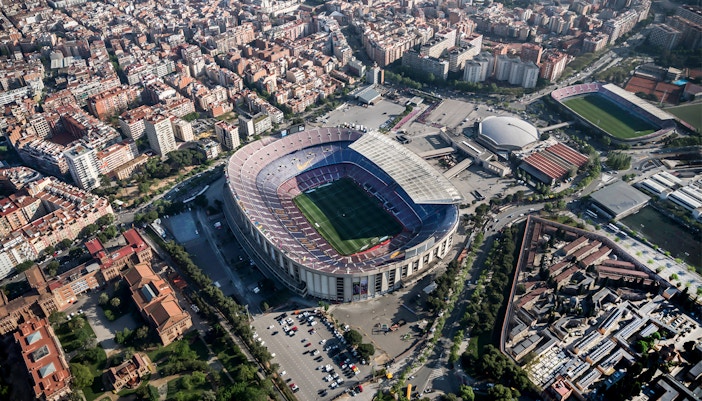
Spotify Camp Nou opened on September 24, 1957, marking a major milestone for FC Barcelona and world football. Built to replace the smaller Les Corts stadium, it became the largest stadium in Europe at the time. The opening match was a friendly between FC Barcelona and a Warsaw XI, ending in a 4–2 victory for Barça. Eulogio Martínez scored the stadium’s first-ever goal.
Spotify Camp Nou history: From 1957 to today
Opened in 1957, Spotify Camp Nou has grown from a monumental football stadium into a global icon of the sport. As the home of FC Barcelona for over six decades, it has witnessed legendary matches, historic moments, and the rise of football greats. From its original construction to its ongoing transformation under the Espai Barça project, Camp Nou continues to evolve, preserving its legacy while looking boldly to the future.
Spotify Camp Nou timeline
- 1954: Construction begins on Spotify Camp Nou, aiming to create a groundbreaking stadium that reflects the grandeur of FC Barcelona's legacy.
- 1957: The inaugural match takes place at Spotify Camp Nou.
- 1962: Spotify Camp Nou hosts its first European Cup final, witnessing a thrilling clash between Ajax and Internazionale.
- 1982: The stadium undergoes renovations for the FIFA World Cup, showcasing its adaptability and commitment to hosting international events.
- 1994: The stadium's capacity is reduced to 99,354 after the removal of standing areas. The pitch is lowered by 2.5 meters to improve visibility.
- 1999: An unforgettable moment occurs as Spotify Camp Nou witnesses Rivaldo's astonishing bicycle kick goal.
- 2000: The stadium celebrates its 50th anniversary with a grand gala.
- 2010: The Spotify Camp Nou Experience, a unique and interactive museum, opens its doors.
- 2011: Spotify Camp Nou becomes the first stadium in Europe to reach a staggering 120,000 spectator capacity.
- 2017: Spotify Camp Nou announces plans for a major renovation project, aimed at enhancing the fan experience and modernizing the stadium for future generations.
- 2022: Spotify partners with Camp Nou, bringing the power of music and sports together.
- 2023: The Espai Barça redevelopment begins, with FC Barcelona temporarily relocating matches to Estadi Olímpic Lluís Companys.
- 2025: Spotify Camp Nou partially reopens for matches in late 2025, marking Barça's return home during the final phases of construction.
Spotify Camp Nou history explained
Opening of Spotify Camp Nou (1957)

Hosting the 1982 FIFA World Cup (1982)
In 1982, Spotify Camp Nou was one of the key venues for the FIFA World Cup held in Spain. It hosted the tournament’s opening ceremony and several matches, putting Barcelona on the global sporting map. The event elevated the stadium’s prestige as a world-class venue.
Rivaldo’s iconic goal (1999)
On November 21, 1999, Rivaldo scored an unforgettable bicycle kick goal against Valencia at Camp Nou. This moment is widely remembered as one of the greatest goals in football history and earned the title of “Best Goal of the Century” by FIFA.

Launch of the Camp Nou Experience (2010)
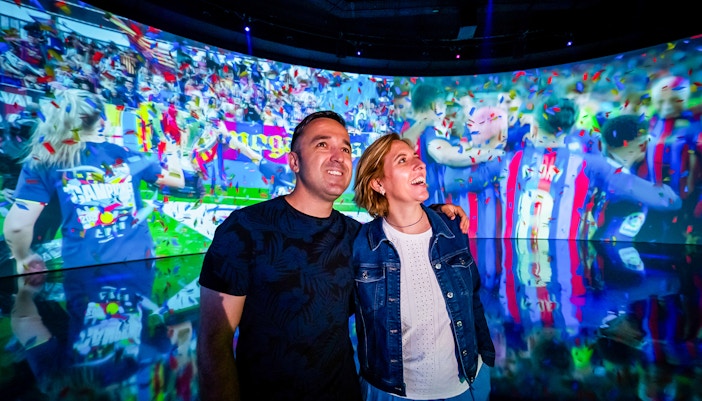
In 2010, the Camp Nou Experience opened to the public—an interactive museum and stadium tour that lets visitors explore the club’s history, trophies, and behind-the-scenes areas like the locker rooms and pitchside. It has since become one of Barcelona’s top tourist attractions.

Espai Barça project begins (2023)
Work on the Espai Barça redevelopment officially began in 2023, signaling a bold transformation of the stadium and surrounding facilities. FC Barcelona played at Estadi Olímpic Lluís Companys during this period and returned to Spotify Camp Nou in late 2025, with matches now taking place while the final stages of construction continue.

The future of Spotify Camp Nou (2026)
The renovation is expected to be fully completed in 2027. Key upgrades include:
- A new roof covering all seats
- Increased capacity of over 105,000 spectators
- Improved facilities, accessibility, and sustainability features
Construction of Spotify Camp Nou
The construction of Spotify Camp Nou began in 1954, designed by the famous Catalan architect Francesc Mitjans Miró. Drawing inspiration from the Roman Colosseum, the design balanced modern engineering with timeless style. The stadium was built using innovative methods such as prefabricated concrete and a pioneering cable-stayed roof structure.
Building on swampy land presented challenges, as did the political climate of the time, but after five years of hard work, the stadium officially opened in 1957. From hosting the 1982 FIFA World Cup to unforgettable UEFA Champions League finals, Camp Nou has witnessed some of football’s most historic moments.
Today, Spotify Camp Nou is more than just a stadium; it’s a global icon and one of Barcelona’s most visited attractions, drawing millions of fans and tourists every year.
Camp Nou today

Today, Spotify Camp Nou stands as a proud symbol of FC Barcelona's legacy and ambition. The stadium has partially reopened for matches while the Espai Barça redevelopment continues, with full completion expected in 2027.
The FC Barcelona Museum and immersive experiences remain open throughout, allowing fans to keep engaging with the club's rich history. More than just a stadium, Camp Nou today represents the spirit of "Més que un club", where football, community, and Catalan pride come together.
Frequently asked questions about Spotify Camp Nou history
Camp Nou officially opened on September 24, 1957, replacing the old Les Corts stadium.
The original stadium was designed by Francesc Mitjans, Josep Soteras, and Lorenzo García-Barbón.
Les Corts had become too small for the growing number of FC Barcelona fans, and a larger, modern stadium was necessary to meet demand.
The inaugural match was a friendly between FC Barcelona and a Warsaw XI. Barcelona won 4–2, and Eulogio Martínez scored the first goal.
Yes, Camp Nou was one of the venues for the 1982 FIFA World Cup, including the opening match and several key games.
In 1999, Rivaldo scored a legendary bicycle kick goal against Valencia, helping Barça qualify for the Champions League. It is widely considered one of the best goals in football history.
Launched in 2010, the Camp Nou Experience is an interactive museum and stadium tour offering insights into FC Barcelona’s history and behind-the-scenes access.
Under the Espai Barça project, Spotify Camp Nou is being upgraded with modern facilities, increased seating capacity, and sustainability features. The stadium has partially reopened for matches since late 2025, with full completion expected in 2027.
The renovated stadium will feature a new roof, expanded seating, modern amenities, and improved accessibility, making it one of the most advanced stadiums in Europe.
No. It was simply called Camp Nou until 2022, when Spotify acquired naming rights as part of a partnership with FC Barcelona.